💡 Compression Method
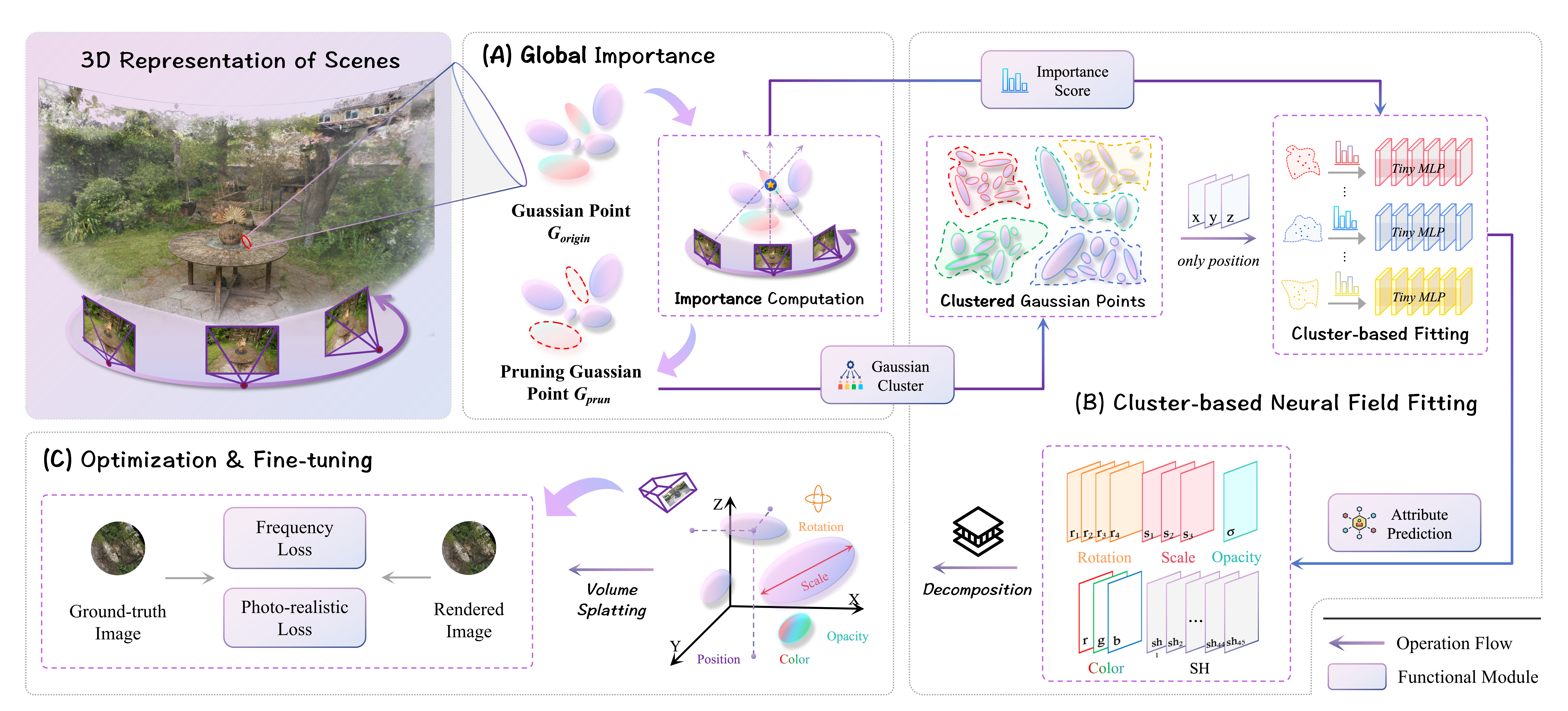
We propose a simple yet effective framework NeuralGS, which adopts the neural field representation to encode the attributes of 3D Gaussians with MLPs to enable a compact 3D representation. Specifically, as shown in Figure 1, we use a designed criterion to assess the importance of each Gaussian, allowing us to prune Gaussians that have minimal impact on renderings. To reduce variations among Gaussians, we cluster these 3D Gaussians based on their attributes, ensuring similarity within each cluster. Then, each cluster is then assigned a tiny MLP that fits the attributes of its 3D Gaussians. Given the varying contributions of each Gaussian to the renderings, we apply Gaussian’s importances as the fitting weights in the MLP fitting. We also incorporate a fine-tuning stage along with frequency loss to restore quality and preserve high-frequency details. We address the storage and rendering issue of 3D Gaussian Splatting (3DGS) by compressing the reconstructed scene parameters and rendering the compressed representation via GPU rasterization. To compress the scenes, we first analyze its components and observe that the Spherical Harmonics (SH) coefficients and the multivariate Gaussian parameters take up the majority of storage space and are highly redundant. Our compression pipeline consists of three steps: